JOSEPH PENNELL:
THE WORLD WAS HIS STUDIO
The Panama Canal Review, February 1965
| "Don't
look like much!" a Panama Canal steam shovel operator remarked in 1912 when he first
saw Joseph Pennell, noted American artist whose lithograph prints of Canal construction
scenes are an important part of the Canal Zone Library-Museum collection. Pennell probably did not look like much at
that. He arrived at the construction site dressed in in tweeds with a portfolio and
a campstool under his arm, his waistcoat pockets full of pencils, and his eyes half shut
in the artist's way which suggests sleepiness to the uninitiated. He had no big
umbrella, no big easel, and none of the paraphernalia by which the artist outdoors
proclaims his profession.
According to a biography written of
the artist by his wife, "the man at the steam shovel changed his opinion before the
morning was over, deciding that Pennell could draw. Pennell, in the end, presented
him with a print; the two had learned to respect each other as good workmen, each after
his fashion." |
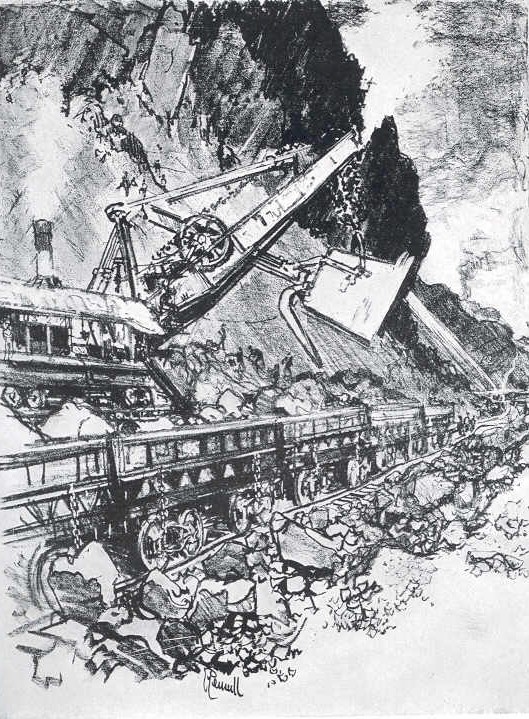
Steam Shovel at Work in
the Culebra Cut
Joseph Pennell, 1912
|
During the time he was
in Panama -January to March 1912- Pennell came to respect many other Canal construction
men as good workmen and dedicated men.
In his introduction to The Panama Canal Pictures, Pennell said, "The
interest of these Americans in my work and in their work was something I had never seen
before. A man in huge boots, overalls and a ragged shirt, an apology for a heat, his
sleeves up to his shoulders, proved himself in a minute a graduate of a great school of
engineering. He proved as well his understanding of the importance of the work he
was trying to do, and his regret that most painters could not see the splendid motives all
about; and the greatest compliment I ever received came from one of these men, who told me
my drawings 'would work'."
Pennell, who was afraid that he had arrived in Panama too late to get the pictures he
wanted, found instead that the construction was exactly at the right stage. As his
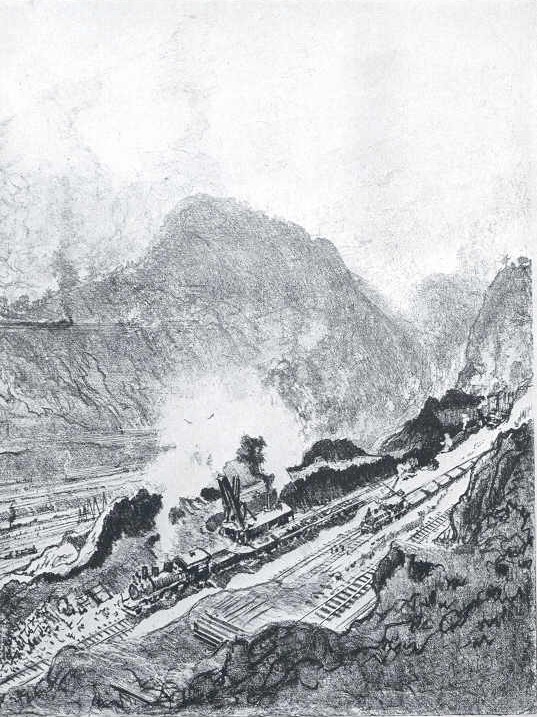
world-famous lithographs show, "industry at the Canal was on a colossal scale.
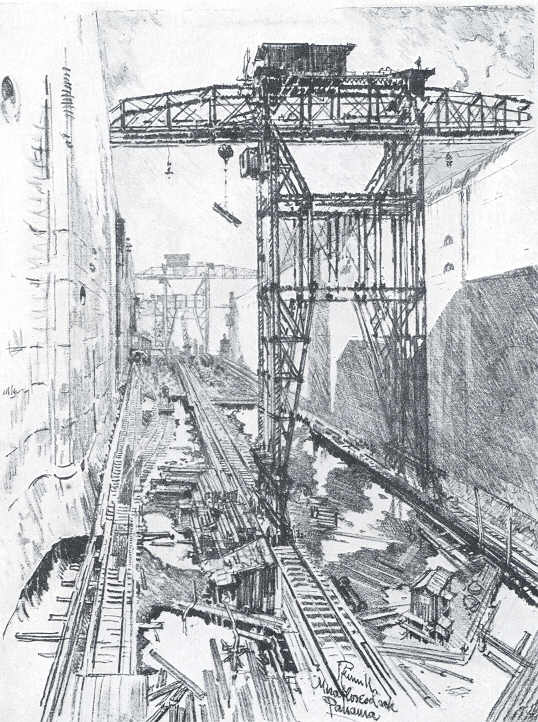
The locks were yawning gulfs, their stupendous arches and buttresses not yet hidden as
they would be once the water was let in."
|
|
The Cut
from Culebra
Joseph Pennell, 1912 |
Cranes
- Miraflores Lock
Joseph Pennell, 1912 |
Pennell later expressed
himself as no less impressed with the order that went with the construction activity and
the apparent pleasure of everyone -high or low- with the work they were doing.
"The workmen worked as if to work was neither a hardship nor an imposition. I
never met anyone who wanted to leave; and I believe that the threat to send the men home
broke the only strike on the Canal."

The American Village
Joseph Pennell, 1912
Although Pennell is best known locally for the 30 lithographs drawn of
Canal construction, he was a famous artist and an authority on etching and lithograph and
a picturesque personality, as well, long before he came to Panama.
A Quaker born in Philadelphia in 1857, he had the Friends' habit of speaking his mind, a
good journalistic sense, and a gift for salesmanship which brought him success by the time
he was 25. His first important work was to illustrate a series of articles by George
W. Cable on New Orleans. The New Orleans etchings and drawings made such a stir that
he was asked to go to Italy to illustrate articles by William Dean Howells.
He married Elizabeth Robins in 1884 and they spent their honeymoon taking a tandem bicycle
trip through England. Later they traveled by bicycle through Europe -he sketching
and Mrs. Pennell writing. Pennell's etchings made an impression in Europe and were
first shown at the Exhibition of the Society of Painters-Etchers in 1885. he
produced an amazing amount of work with most of it being reproduced in American and
English magazines. He also illustrated a number of books.
He was interested as much in the art of printing from plates as in making them and
believed both processes were equally the business of the etcher. Later his close
association with James McNeill Whistler made it natural that lithography would attract
him. He really became enthusiastic over the process in 1895 and in 1909 founded the
Senefelder Club in London to bring lithographers together and hold exhibitions of their
prints.
He felt that the art was a medium peculiarly well adapted to the portrayal of factories
and he described these industrial prints as "The Wonder of Work" of which the
Panama lithographs were part. The Panama drawings, it was said, were never surpassed
for richness of color and virile strength. During World War I, he made lithographs and
drawings of British plants engaged in war work later published as "Joseph
Pennell's pictures of War Work in England," and worked on several projects in the
United States. After the war, he taught etching at the Arts Students' league in New York,
wrote several books, served as an art critic on the Brooklyn Eagle, and helped run the New
Society of Sculptors, Painters & Engravers. He died in 1926.
Pennell is considered to have done more than any other one artist of his time to improve
the quality of illustration both in the United States and abroad and to raise its status
as an art. He produced more than 900 etched and mezzotint plates, some 621
lithographs, and innumerable drawings and water colors.
He was a member of numerous societies both in the United States and Europe, was awarded
medals at many expositions, and his work is represented in museums and galleries in
various parts of the world.
Presented by
CZBrats
September 4, 2000

